


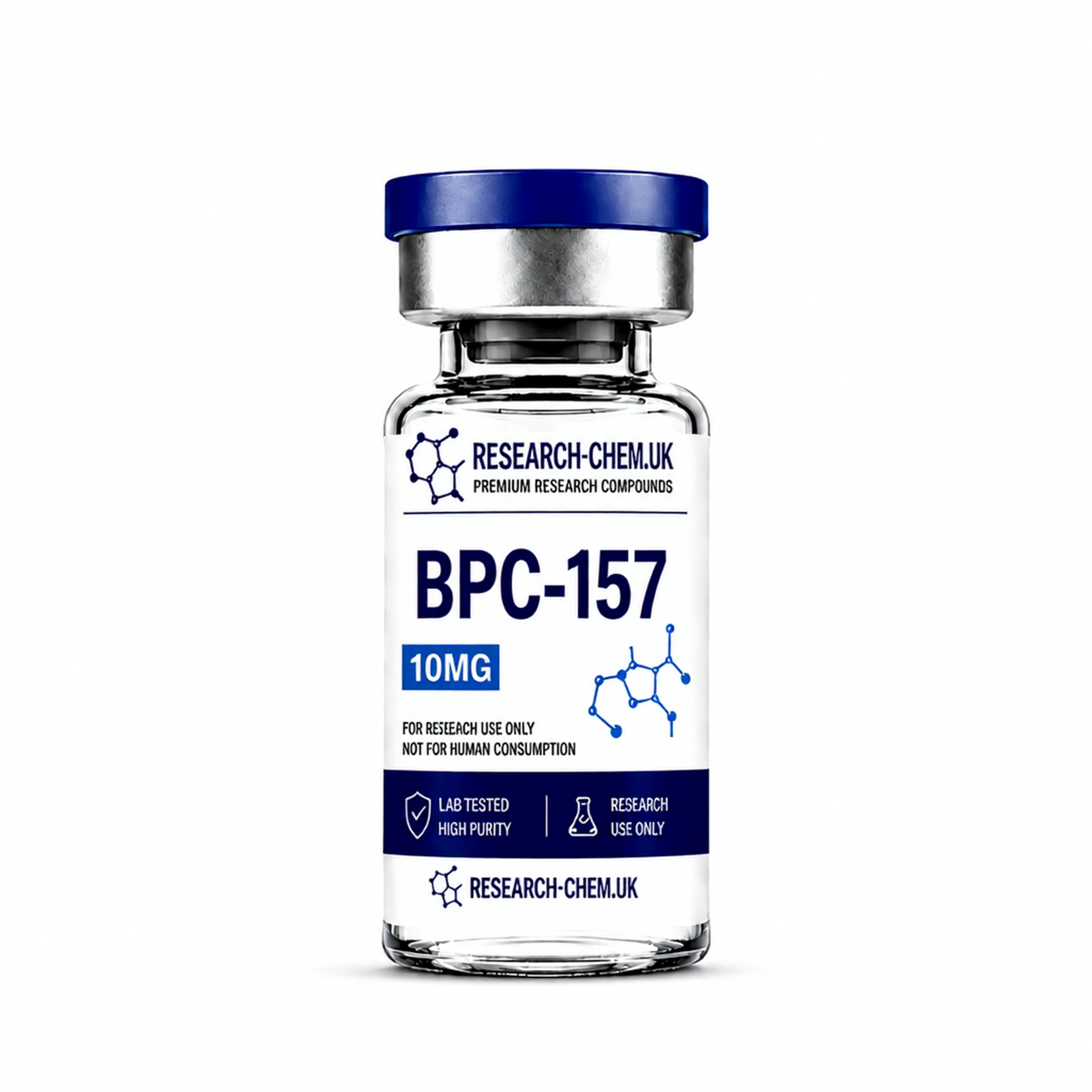
 RESEARCH USE ONLY
10MG
BPC-157
10MG · CAS: 137525-51-0
Certificate of Analysis
Batch HPLC & MS included
UK Dispatch
Shipped next working day
Research Grade
≥98% documented purity
Discreet Packaging
Plain, secure, tamper-evident
Laboratory Research Use Only: This compound is sold exclusively for qualified in-vitro scientific and laboratory investigation. Strictly not intended for human or veterinary administration.
Product Overview
BPC-157, commonly referred to as Body Protection Compound 157 or Stable Gastric Pentadecapeptide BPC-157, is a synthetic peptide consisting of 15 amino acids. Its sequence is GEPPPGKPADDAGLV, with a molecular weight of approximately 1,419 Da.
The compound originates from research into a peptide sequence associated with the body's natural gastric protection mechanisms. BPC-157 has subsequently been investigated extensively in pre-clinical research, particularly in models involving tissue biology, cellular protection, vascular signalling and musculoskeletal repair.
Research involving BPC-157 has examined a wide variety of biological systems, including tendon, ligament, muscle, bone, gastrointestinal tissue, cardiovascular tissue and neurological models.
This product is supplied strictly for controlled laboratory research.
What Is BPC-157?
BPC-157 is a synthetic pentadecapeptide made up of 15 amino acids. It was originally associated with research into compounds identified in human gastric juice and has since become the subject of substantial pre-clinical investigation.
The peptide has attracted research interest because of its apparent activity across several biological pathways rather than being limited to a single mechanism.
Experimental studies have investigated BPC-157 in relation to:
- Cellular protection and stress responses
- Vascular and angiogenic signalling
- Fibroblast migration and tissue remodelling
- Tendon and ligament research
- Gastrointestinal protection models
- Oxidative stress
- Inflammatory signalling
- Neurological and neurotransmitter-related models
It is important to distinguish these laboratory findings from established human medical outcomes. Much of the available evidence remains pre-clinical, and human clinical data are limited.
Alternative Names
BPC-157 may also be identified in research literature as:
- Body Protection Compound 157
- Stable Gastric Pentadecapeptide BPC-157
- PL-10
- PLD-116
- PL 14736
- Bepecin
- GEPPPGKPADDAGLV
How Is BPC-157 Investigated in Research?
The biological activity of BPC-157 appears to involve several interconnected signalling pathways. However, its mechanisms are not completely characterised across every tissue or experimental model.
VEGFR2 / Akt / eNOS Signalling
Research has examined BPC-157 in relation to vascular endothelial growth factor receptor 2 (VEGFR2) and its downstream Akt/eNOS signalling pathway. This pathway is associated with endothelial activity and angiogenesis, making it an area of interest in experimental studies investigating vascular recruitment and tissue repair.
Growth Hormone Receptor Signalling
Experimental work has also examined the relationship between BPC-157 and growth hormone receptor (GHR) expression in tendon fibroblasts. Studies have reported changes in GHR expression following exposure to BPC-157, with subsequent research investigating interactions with the GH/JAK2/STAT signalling pathway and processes such as fibroblast activity and extracellular matrix production.
HO-1 and Cellular Protection
Another area of investigation involves haem oxygenase-1 (HO-1), an enzyme involved in cellular defence and oxidative-stress responses. Research has explored whether BPC-157 can influence HO-1-related pathways and cellular responses to oxidative damage, including experimental models involving lipid peroxidation and ischaemia-reperfusion injury.
Fibroblast Migration and Tendon Biology
BPC-157 has been investigated extensively in tendon-related laboratory models. Studies have examined processes including tendon explant outgrowth, fibroblast migration and cellular survival under experimentally induced oxidative stress. These findings have contributed to interest in BPC-157 as a research compound for studying cellular mechanisms involved in connective-tissue repair.
Nitric Oxide and Vascular Signalling
Nitric oxide signalling is another area associated with BPC-157 research. Experimental investigations have examined relationships between BPC-157, endothelial signalling and vascular responses, including pathways connected with VEGFR2, Akt and eNOS.
FAK / Paxillin Signalling
Research has also investigated focal adhesion kinase (FAK) and paxillin, proteins involved in cell adhesion, migration and interaction with the extracellular matrix. This pathway may help explain some of the observed effects on fibroblast movement and cellular motility in experimental tissue models.
Gastrointestinal Research
BPC-157 was originally investigated in the context of gastric biology. Research areas have included:
- Gastric mucosal integrity
- Ulcer models
- Intestinal permeability
- NSAID-related injury
- Ethanol-induced injury
- Gastrointestinal stress models
Neurological Research
Pre-clinical research has also investigated BPC-157 in neurological models, including studies involving serotonergic, dopaminergic and GABAergic signalling. These findings have expanded research interest in the peptide beyond musculoskeletal and gastrointestinal models.
BPC-157 Research Applications
BPC-157 has been investigated across a broad range of pre-clinical models. Areas of research include:
- Tendon biology: Achilles tendon injury, fibroblast migration, tissue outgrowth and biomechanical studies
- Ligament research: MCL and ACL injury models and connective-tissue remodelling
- Muscle research: experimental muscle injury and repair models
- Bone research: fracture healing and bone-defect models
- Gastrointestinal research: mucosal protection, ulcer and permeability models
- Inflammatory bowel research: colitis and intestinal healing models
- Liver and pancreas studies: experimental organ-protection models
- Angiogenesis: VEGFR2/Akt/eNOS signalling and vascular recruitment
- Growth hormone signalling: GHR expression and GH/IGF-1 pathway research
- Oxidative stress: HO-1 and cellular protection studies
- Cell migration: FAK/paxillin signalling and fibroblast motility
- Cardiovascular research: endothelial, fistula and cardiac models
- CNS research: neurotransmitter signalling and neuroinflammatory models
- Ocular research: corneal injury and wound-healing models
- Inflammation: cytokine and inflammatory pathway research
- Comparative pharmacology: comparison with growth factors and other research compounds
What Does the Research Say?
A substantial proportion of the BPC-157 literature comes from pre-clinical laboratory and animal studies.
Tendon Research
Early experimental studies investigated BPC-157 using Achilles tendon injury models. Researchers reported changes in measures associated with tendon repair, including biomechanical properties, fibroblast activity and collagen formation. Further laboratory work examined tendon explant outgrowth and fibroblast migration, providing additional evidence for investigating the peptide's effects on cellular repair processes.
Fibroblast and Cellular Research
Subsequent studies have explored the effects of BPC-157 on tendon fibroblasts, including cellular migration, survival and growth-hormone-receptor expression. These studies provide potential mechanistic explanations for some of the effects observed in experimental tendon models, although they should not be interpreted as proof of therapeutic effectiveness in humans.
Recent Reviews
More recent reviews have examined the wider BPC-157 literature, including research relating to musculoskeletal models, tissue biology and potential mechanisms of action. The existing literature remains predominantly pre-clinical. A significant limitation is the relatively small amount of controlled human clinical evidence currently available.
Selected Research References
The literature discussed in connection with BPC-157 includes studies such as:
- Sikiric P et al. (1993), Journal of Physiology-Paris
- Staresinic M et al. (2003), Journal of Orthopaedic Research
- Chang CH et al. (2011), Journal of Applied Physiology
- Chang CH et al. (2018), Frontiers in Physiology
- Borrelli F et al. (2019), Cell and Tissue Research
- Vasireddi N et al. (2025), Orthopaedic Journal of Sports Medicine
- Ziaja M et al. (2025), Pharmaceuticals
Researchers should consult the original publications when assessing experimental findings, methodology and limitations.
BPC-157 Compared With Other Research Peptides
BPC-157 is one of several peptides investigated in relation to tissue biology and cellular signalling. These comparisons describe research areas rather than established clinical uses.
| Feature | BPC-157 | TB-500 / Thymosin β4 | GHK-Cu | KPV |
|---|---|---|---|---|
| Research origin | Gastric-derived peptide sequence | Thymosin β4-related research | Copper-binding tripeptide | α-MSH-derived tripeptide |
| Main research pathways | VEGFR2/Akt/eNOS, GHR/JAK2, HO-1, FAK/paxillin | Actin and VEGF-related pathways | Collagen, angiogenesis and MMP-related pathways | Melanocortin-related signalling |
| Tendon research | Extensive pre-clinical literature | Investigated | Moderate research | Limited |
| GI research | Extensive | More limited | Limited | Investigated |
| CNS research | Investigated | Limited | Investigated | Investigated |
| GHR research | Investigated | Not established | Not established | Not established |
| Research format | Lyophilised peptide | Research peptide | Research peptide | Research peptide |
Quality and Purity
Quality control is an important consideration when working with research peptides. Research-Chem.uk supplies BPC-157 with the following stated specifications:
- Greater than 99% purity
- HPLC verified
- Mass-spectrometry verified
- Batch-specific COA documentation available
- Supplied as lyophilised powder
- Produced under controlled laboratory conditions
- Subject to batch-level quality verification
A Certificate of Analysis can be requested for the relevant batch.
BPC-157 Product Specifications
| Property | Specification |
|---|---|
| Product | BPC-157 / Body Protection Compound 157 |
| Alternative names | Stable Gastric Pentadecapeptide BPC-157, PL-10, Bepecin |
| Sequence | GEPPPGKPADDAGLV |
| Amino acids | 15 |
| Molecular weight | Approximately 1,419.5 Da |
| Purity | >99%, HPLC verified |
| Form | Lyophilised powder |
| Storage | Dry storage at -20°C, protected from light |
Laboratory Research Applications
The product is intended solely for controlled laboratory and scientific research. Potential research applications include:
- Connective-tissue biology
- Tendon and ligament models
- Muscle and bone research
- Gastrointestinal cellular models
- Angiogenic signalling
- Fibroblast migration
- Oxidative-stress pathways
- GHR/JAK2 signalling
- HO-1-mediated cellular protection
- FAK/paxillin signalling
- Inflammatory pathways
- Cardiovascular models
- Neurological research
- Comparative peptide and growth-factor studies
- Analytical and anti-doping research
Why Choose Research-Chem.uk?
Research-Chem.uk supplies research-grade peptides intended for laboratory use. For BPC-157, customers receive:
- Purity verification above 99%
- HPLC and mass-spectrometry testing
- Batch-specific COA documentation
- Lyophilised research material
- UK dispatch
- Tracked delivery options
- Bulk research purchasing options
The emphasis is on traceability, batch consistency and documentation for laboratory researchers.
Research-Use Disclaimer
BPC-157 is supplied strictly as a research compound for laboratory and in-vitro scientific investigation.
It is not intended for human consumption, veterinary use, diagnosis, treatment, prevention of disease, or any other medical or therapeutic purpose.
BPC-157 is not presented as an approved medicine, and the pre-clinical findings described above should not be interpreted as evidence of established safety or effectiveness in humans.
Human clinical evidence remains limited, and laboratory or animal findings cannot automatically be applied to human health.
Researchers are responsible for ensuring that any use of research compounds complies with applicable legislation, institutional policies, laboratory procedures and relevant regulatory requirements.
For qualified researchers and controlled laboratory research use only.