


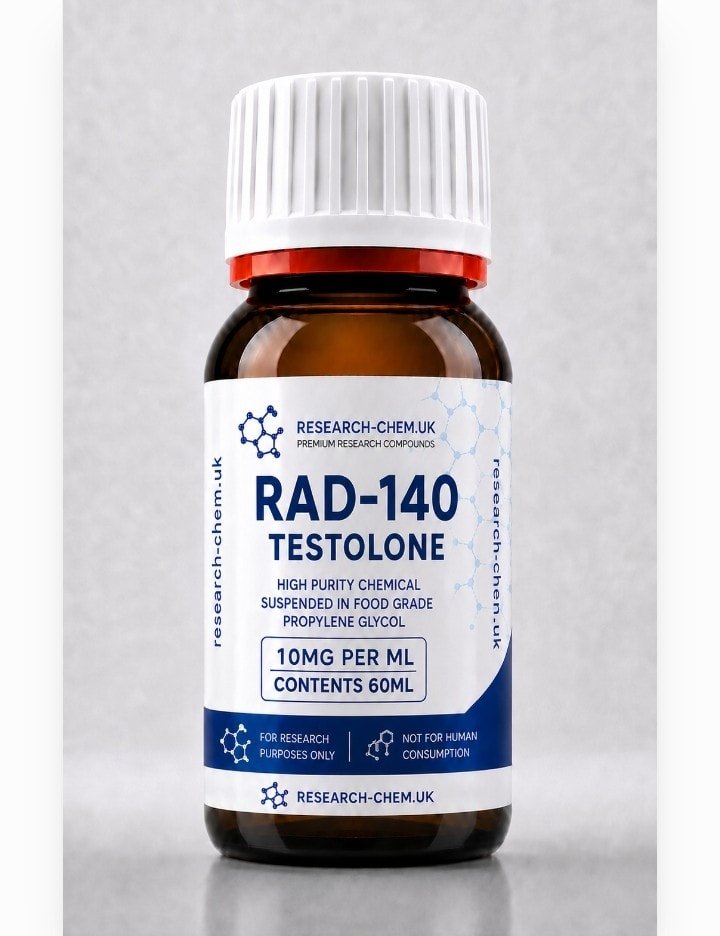
 RESEARCH USE ONLY
10mg per ml
RAD-140
Testolone · CAS: 1182367-47-0
Certificate of Analysis
Batch HPLC & MS included
UK Dispatch
Shipped next working day
Research Grade
≥98% documented purity
Discreet Packaging
Plain, secure, tamper-evident
Laboratory Research Use Only: This compound is sold exclusively for qualified in-vitro scientific and laboratory investigation. Strictly not intended for human or veterinary administration.
Product Overview
RAD-140, commonly known as Testolone or Vosilasarm, is a synthetic, non-steroidal selective androgen receptor modulator (SARM). RAD-140 was developed as an investigational compound designed to selectively interact with androgen receptors. Preclinical research has examined its receptor activity, tissue selectivity and potential applications in conditions involving androgen-receptor signalling.
Unlike anabolic-androgenic steroids, RAD-140 is structurally distinct from testosterone and other steroid hormones. Its research significance comes from its ability to interact directly with the androgen receptor (AR) while being chemically unrelated to traditional steroidal androgens. Research-Chem.uk supplies RAD-140 as a laboratory research compound intended strictly for analytical and scientific research applications.
| Key Product Features | |
|---|---|
| Product | RAD-140 |
| Alternative Names | Testolone / Vosilasarm |
| Compound Type | Non-steroidal selective androgen receptor modulator |
| Primary Target | Androgen receptor |
| CAS | 1182367-47-0 |
| Molecular Formula | C₂₀H₁₆ClN₅O₂ |
| Molecular Weight | 393.8 g/mol |
| Testing | HPLC verified |
| Documentation | Batch-specific Certificate of Analysis (COA) |
| Application | Laboratory research only |
| Dispatch | UK |
What Is RAD-140?
RAD-140 is a synthetic small molecule belonging to the selective androgen receptor modulator class. SARMs are designed to interact with androgen receptors in a tissue-selective manner. The underlying research objective is to investigate whether androgen-receptor signalling can be modulated while producing a different biological profile from conventional anabolic steroids.
RAD-140 was developed by researchers investigating next-generation androgen receptor ligands. Preclinical characterisation demonstrated strong androgen-receptor activity and anabolic effects in experimental models.
RAD-140 is also known by the names Testolone, Testalone, Vosilasarm and EP0062.
According to PubChem, the compound has the following chemical identity:
- CAS: 1182367-47-0
- Formula: C₂₀H₁₆ClN₅O₂
- Molecular weight: 393.8 g/mol
- PubChem CID: 44200882
How Is RAD-140 Investigated in Research?
RAD-140 has been investigated primarily through receptor pharmacology, preclinical animal models and early-stage human clinical research. Research has examined:
- Androgen receptor binding
- Androgen receptor activation
- Tissue-selective androgen signalling
- Skeletal-muscle biology
- Bone biology
- Muscle-wasting models
- Cancer-related androgen receptor signalling
- Pharmacokinetics
- Metabolism
- Safety and tolerability
The principal research interest is the ability of RAD-140 to activate androgen receptors in selected tissues. Preclinical SARM research has generally sought to investigate whether selective receptor activation can produce anabolic effects in tissues such as skeletal muscle and bone while reducing some of the broader androgenic effects associated with conventional steroidal compounds.
However, selectivity does not mean absence of biological or safety effects. RAD-140 remains an investigational compound, and human research has identified clinically relevant adverse events that must be considered when evaluating the compound.
RAD-140 Research Applications
Androgen Receptor Research
RAD-140 is primarily used as an experimental ligand for studying the androgen receptor. Researchers can investigate:
- AR activation
- AR-dependent gene transcription
- Receptor-ligand interactions
- Tissue-specific androgen signalling
- Androgen-responsive cellular pathways
This makes RAD-140 relevant to molecular pharmacology and receptor-signalling research.
SARM Research
RAD-140 is one of the compounds commonly investigated within the broader field of selective androgen receptor modulation. Research can compare RAD-140 with:
- Testosterone
- Dihydrotestosterone
- Other SARMs
- Steroidal androgen receptor ligands
These comparisons can help researchers investigate differences in receptor activation, transcriptional responses and tissue-specific activity.
Skeletal-Muscle Research
Preclinical research has investigated RAD-140 in relation to skeletal-muscle biology and anabolic signalling. These studies provide an experimental framework for examining how selective androgen-receptor activation influences muscle-associated pathways.
Importantly, laboratory findings should not be interpreted as evidence supporting recreational or performance-enhancing use.
Bone Research
Androgen receptor signalling is also important in bone physiology. SARMs including RAD-140 have therefore been investigated in experimental models examining:
- Bone formation
- Bone mineralisation
- Osteoblast activity
- Skeletal androgen signalling
These models allow researchers to examine potential tissue-specific effects of androgen-receptor activation.
Muscle-Wasting Research
One of the original research objectives for SARMs was to investigate their potential in conditions involving muscle loss or reduced anabolic signalling. RAD-140 has been investigated in preclinical models relevant to muscle wasting and cachexia.
These studies are useful for understanding androgen receptor biology, although preclinical activity does not establish clinical efficacy.
Cancer Research
Androgen receptor signalling plays an important role in several hormone-sensitive cancers. RAD-140 has consequently been investigated as an experimental AR ligand in cancer research, particularly in relation to androgen-receptor-positive tumour biology.
Its development history has included investigation in hormone-sensitive breast cancer, providing a separate research context from the recreational use for which SARMs are sometimes marketed online.
What Does the Research Say?
RAD-140 was designed as a selective androgen receptor modulator, and early preclinical research demonstrated strong activity at the androgen receptor. The research programme surrounding SARMs has sought to identify compounds capable of producing anabolic receptor activity with a different tissue profile from traditional anabolic steroids.
RAD-140 subsequently progressed into human clinical investigation. PubChem records a Phase 2 development stage, reflecting its investigational pharmaceutical history. However, the human evidence base remains considerably smaller than that for established androgenic medicines.
Importantly, clinical and post-market-style reports have raised concerns regarding potential adverse effects associated with RAD-140 exposure. A published case report described drug-induced liver injury associated with RAD-140 use, with liver function returning toward normal following discontinuation. Another report documented severe liver injury associated with RAD-140 used as a bodybuilding product.
Additional case literature has reported serious cardiovascular events associated with RAD-140 exposure, including a published report concerning heart failure and another concerning myopericarditis. These individual reports cannot establish incidence or causality on their own, but they are relevant when considering the compound's safety profile.
Consequently, RAD-140 should be viewed scientifically as an investigational androgen-receptor ligand, rather than as a proven alternative to approved androgenic medicines.
For laboratory research, its principal value is in studying androgen receptor pharmacology, selective receptor activation and tissue-specific androgen signalling.
Research References
-
Miller CP, et al. (2011). Design, synthesis, and preclinical characterization of the selective androgen receptor modulator RAD140. ACS Medicinal Chemistry Letters.
The foundational preclinical research describing the design and characterisation of RAD-140 as a selective androgen receptor modulator.
-
Solomon ZJ, et al. (2019). Selective Androgen Receptor Modulators: Current Knowledge and Clinical Applications. Sexual Medicine Reviews, 7(1), 84–94.
PMID: 30503797 · DOI: 10.1016/j.sxmr.2018.09.006
-
RAD-140 / Testolone — PubChem CID: 44200882. CAS: 1182367-47-0. Molecular formula: C₂₀H₁₆ClN₅O₂. Molecular weight: 393.8 g/mol.
-
Idiosyncratic drug-induced liver injury related to use of novel selective androgen receptor modulator RAD140 (Testalone): a case report.
PMID: 36978171
-
Severe liver injury following use of RAD-140, a selective androgen receptor modulator, for bodybuilding. Australian Prescriber, 2024.
PMID: 38444893
-
Selective androgen receptor modulator abuse-induced heart failure: catastrophic effects of RAD-140 (Testolone). Polish Archives of Internal Medicine, 2024.
PMID: 38864168
-
Myopericarditis Following Use of Selective Androgen Receptor Modifier "RAD-140". Published case report concerning cardiovascular effects associated with RAD-140 exposure.
PMID: 39157568
RAD-140 Product Specifications
| Specification | Details |
|---|---|
| Product Name | RAD-140 |
| Alternative Names | Testolone / Vosilasarm |
| Compound Type | Non-steroidal SARM |
| Primary Target | Androgen receptor |
| CAS Number | 1182367-47-0 |
| Molecular Formula | C₂₀H₁₆ClN₅O₂ |
| Molecular Weight | 393.8 g/mol |
| Testing Method | HPLC |
| Physical Form | Research compound |
| Intended Application | Laboratory research only |
| Documentation | Batch-specific COA |
Quality and Purity
At Research-Chem.uk, analytical quality and batch traceability are central to our research compound range.
RAD-140 is supplied as a defined research compound with analytical documentation supporting material identification and laboratory record keeping. HPLC analysis is used as part of the analytical quality-control process, with batch-specific documentation available.
Researchers should always refer to the relevant Certificate of Analysis (COA) when recording the analytical characteristics of a particular batch.
Laboratory Research Applications
RAD-140 may be suitable for laboratory investigations involving:
- Androgen receptor pharmacology
- Selective androgen receptor modulation
- Receptor-ligand interactions
- AR-dependent gene expression
- Tissue-selective androgen signalling
- Skeletal-muscle biology
- Bone biology
- Muscle-wasting research
- Cancer biology
- Hormone-receptor research
- Molecular pharmacology
- Small-molecule pharmacokinetics
- Drug-metabolism research
- Analytical chemistry
RAD-140 is supplied strictly as a research compound and is not intended to diagnose, treat, cure or prevent any disease or medical condition.
Why Choose Research-Chem.uk?
Research-Chem.uk provides research compounds for laboratories, analytical researchers and other qualified research environments. Our range focuses on:
HPLC-Verified Materials
Research compounds are subjected to analytical purity assessment, with batch-specific documentation available.
Batch Traceability
Products are supplied with Certificate of Analysis documentation to support laboratory record keeping and material identification.
UK Dispatch
Research compounds are dispatched from the UK for efficient domestic delivery.
Research-Only Positioning
Our products are supplied exclusively for legitimate laboratory research and analytical applications.
Clear Product Specifications
Each product page provides defined information about compound identity, analytical characteristics and relevant scientific context.
Research-Use Disclaimer
For laboratory research use only. Not for human or veterinary use.
RAD-140 supplied by Research-Chem.uk is intended strictly for laboratory research, analytical testing and scientific investigation.
This product is not a medicine, pharmaceutical preparation, dietary supplement or food product. It is not intended for human consumption, self-administration, diagnosis, treatment, cure or prevention of any disease or medical condition.
RAD-140 is an investigational selective androgen receptor modulator. It is not an approved general-purpose supplement or established alternative to approved androgenic medicines. Published case reports have described potentially serious adverse events associated with RAD-140 exposure, including liver injury and cardiovascular complications.
The scientific information presented on this page summarises published research concerning RAD-140 and selective androgen receptor modulation. It is provided for research and educational context only and should not be interpreted as a recommendation for human use.
Researchers and laboratories are responsible for ensuring that all use, handling, storage, testing and disposal procedures comply with applicable legislation, institutional requirements and laboratory safety protocols.
For qualified researchers and controlled laboratory research use only.