


 RESEARCH USE ONLY
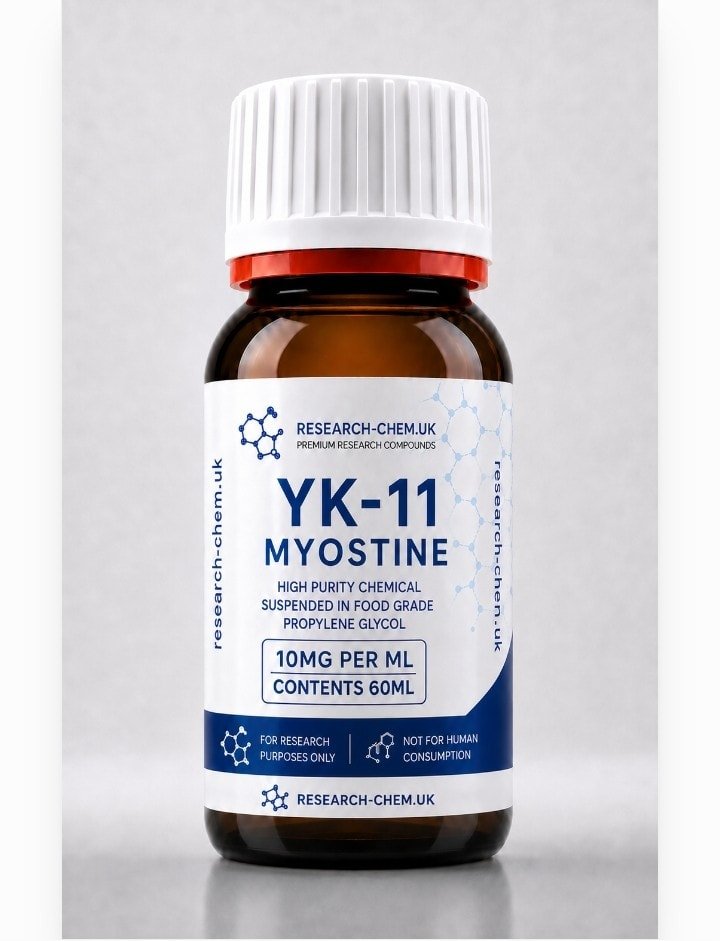
10mg per ml
YK-11
Myostine · CAS: 1370003-76-1
Certificate of Analysis
Batch HPLC & MS included
UK Dispatch
Shipped next working day
Research Grade
≥98% documented purity
Discreet Packaging
Plain, secure, tamper-evident
Laboratory Research Use Only: This compound is sold exclusively for qualified in-vitro scientific and laboratory investigation. Strictly not intended for human or veterinary administration.
Product Overview
YK-11 is a synthetic androgen-receptor-active compound commonly classified and marketed within the selective androgen receptor modulator (SARM) research category. YK-11 is structurally and pharmacologically distinct from many of the better-characterised non-steroidal SARMs. It has attracted particular research interest because experimental studies have investigated its interaction with the androgen receptor (AR) alongside potential effects on follistatin and myostatin-associated pathways.
Unlike non-steroidal SARMs such as RAD-140, YK-11 has a steroidal chemical structure, making precise classification and comparison with other SARMs more complex. Research-Chem.uk supplies YK-11 as a laboratory research compound intended strictly for analytical and scientific research applications.
| Key Product Features | |
|---|---|
| Product | YK-11 |
| Compound Type | Androgen-receptor-active research compound |
| Research Classification | Commonly marketed as a SARM |
| Primary Target | Androgen receptor |
| Additional Research Interest | Follistatin / myostatin-associated signalling |
| Testing | HPLC verified |
| Documentation | Batch-specific Certificate of Analysis (COA) |
| Application | Laboratory research only |
| Dispatch | UK |
What Is YK-11?
YK-11 is a synthetic compound that has been investigated for its activity at the androgen receptor. It is frequently grouped with SARMs in commercial and research settings, but it differs from many classical SARMs because it possesses a steroidal structure rather than the non-steroidal structures found in compounds such as RAD-140, Ostarine and Ligandrol.
Published research on YK-11 is relatively limited compared with more extensively characterised androgen-receptor ligands.
One of the primary scientific interests surrounding YK-11 originates from experimental work investigating its effects on follistatin expression in muscle-derived cells. Follistatin is a protein involved in the regulation of several members of the transforming growth factor-beta (TGF-β) superfamily, including myostatin.
This has led to interest in YK-11 as an experimental compound for studying the relationship between androgen receptor signalling and muscle-regulatory pathways.
However, the proposed mechanisms should be considered preliminary because much of the available YK-11 research consists of cell-based and preclinical investigations rather than extensive human pharmacological studies.
How Is YK-11 Investigated in Research?
Research involving YK-11 has focused primarily on molecular and cellular mechanisms associated with androgen-receptor signalling. Experimental areas include:
- Androgen receptor activation
- AR-dependent gene expression
- Follistatin expression
- Myostatin-associated pathways
- Myogenic differentiation
- Skeletal-muscle signalling
- Muscle-cell proliferation
- Muscle-cell differentiation
- Androgen pharmacology
- Steroidal ligand activity
The original research that generated significant interest in YK-11 examined its effects in C2C12 myoblast cells, a commonly used experimental model for studying skeletal-muscle differentiation. Researchers observed changes in follistatin expression following exposure to YK-11 and investigated whether the compound's effects were associated with androgen-receptor signalling.
This provides a scientific basis for further investigation but does not establish that the same mechanisms or outcomes occur in humans.
YK-11 Research Applications
Androgen Receptor Research
YK-11 is primarily relevant to research involving androgen-receptor signalling. Experimental studies can investigate:
- AR activation
- AR-mediated transcription
- Androgen-responsive genes
- Receptor-ligand interactions
- Steroidal androgen-receptor pharmacology
Because YK-11 differs structurally from non-steroidal SARMs, it can also provide a useful comparison compound when investigating different classes of androgen-receptor ligands.
Follistatin Research
One of the most distinctive areas of YK-11 research concerns follistatin. Follistatin is a secreted glycoprotein that can interact with and regulate members of the TGF-β superfamily. Experimental research has reported increased follistatin expression in muscle-cell models exposed to YK-11. This makes the compound relevant to research examining:
- Follistatin expression
- Follistatin regulation
- Androgen receptor signalling
- Muscle-cell differentiation
- Growth-factor pathways
Myostatin Research
Myostatin is an important regulator of skeletal-muscle development and growth. Because follistatin can interact with myostatin and related signalling molecules, the reported relationship between YK-11 and follistatin has generated interest in potential connections between androgen signalling and myostatin-associated pathways.
However, it is important to distinguish research into follistatin expression from claims that YK-11 has been demonstrated to inhibit myostatin in humans. The latter is not established by the available evidence.
Skeletal-Muscle Cell Research
YK-11 has been investigated using cultured muscle-cell models. The C2C12 cell line is widely used to study:
- Myoblast proliferation
- Myogenic differentiation
- Muscle-cell development
- Myogenic gene expression
- Growth-factor signalling
YK-11 provides an experimental compound for examining how androgen-receptor activity may influence these processes.
Molecular Pharmacology
YK-11 can also be used as a research compound for comparing steroidal and non-steroidal androgen-receptor ligands. Researchers may investigate differences in:
- Chemical structure
- Receptor binding
- Transcriptional activity
- Cellular responses
- Metabolic behaviour
What Does the Research Say?
The research literature surrounding YK-11 is considerably smaller than that available for compounds such as RAD-140 or Ostarine.
The study most frequently associated with YK-11 investigated its effects on C2C12 skeletal-muscle cells. Researchers reported that YK-11 increased follistatin expression and examined evidence suggesting that this response was associated with androgen-receptor signalling. These findings generated interest because follistatin is involved in the regulation of myostatin and other TGF-β-family signalling pathways.
However, the study was conducted using a cellular model, rather than a clinical human population. Consequently, the findings provide mechanistic evidence for further research but cannot establish that YK-11 produces equivalent effects in humans.
The limited nature of the published literature is particularly important when assessing YK-11. Many claims commonly associated with the compound online are substantially broader than the scientific evidence currently available.
There is insufficient clinical research to establish YK-11 as a safe or effective human anabolic agent, therapeutic compound or performance-enhancing substance.
From a laboratory perspective, its greatest research interest lies in the relationship between androgen-receptor signalling, follistatin expression and muscle-cell biology.
Research References
-
Kanno Y, et al. (2011). YK11, a novel anabolic steroid, induces myoblast proliferation and differentiation by activating the androgen receptor and increasing follistatin expression.
Research examining YK-11 in C2C12 skeletal-muscle cells and its relationship with androgen-receptor signalling and follistatin. This study represents the primary published experimental basis for the commonly proposed follistatin-related mechanism of YK-11.
-
Mendell JR, et al. Research into follistatin and myostatin-associated signalling provides broader biological context for interpreting experimental findings involving YK-11.
-
Lee SJ. (2004). Regulation of muscle mass by myostatin. Annual Review of Cell and Developmental Biology, 20, 61–86.
Review describing the biological role of myostatin in skeletal-muscle development and regulation.
-
Sinha-Hikim I, et al. Research concerning androgen-receptor signalling and skeletal-muscle biology provides additional context for investigating androgen-active compounds such as YK-11.
-
Researchers should consult the original publications when evaluating YK-11 because the available evidence is relatively limited and is heavily weighted toward cellular and mechanistic research.
YK-11 Product Specifications
| Specification | Details |
|---|---|
| Product Name | YK-11 |
| Compound Type | Androgen-receptor-active research compound |
| Common Classification | SARM / SARM-like compound |
| Primary Target | Androgen receptor |
| Research Interest | Follistatin and myostatin-associated pathways |
| Testing Method | HPLC |
| Physical Form | Research compound |
| Intended Application | Laboratory research only |
| Documentation | Batch-specific COA |
YK-11 is structurally distinct from the non-steroidal SARMs commonly encountered in research and commercial literature. Researchers should therefore consider its chemical and pharmacological characteristics independently rather than assuming that all SARM-classified compounds share the same mechanism.
Quality and Purity
At Research-Chem.uk, analytical quality and batch traceability are central to our research compound range.
YK-11 is supplied as a defined research compound with analytical documentation supporting material identification and laboratory record keeping. HPLC analysis is used as part of the analytical quality-control process, with batch-specific documentation available.
Researchers should always refer to the relevant Certificate of Analysis (COA) when recording the analytical characteristics of a particular batch.
Laboratory Research Applications
YK-11 may be suitable for laboratory investigations involving:
- Androgen receptor pharmacology
- Selective androgen receptor research
- AR-dependent gene expression
- Follistatin expression
- Myostatin-associated pathways
- Skeletal-muscle cell biology
- Myoblast proliferation
- Myogenic differentiation
- Muscle-regulatory signalling
- Steroidal androgen-receptor ligands
- Receptor-ligand interactions
- Molecular pharmacology
- Cell-based research
- Analytical chemistry
YK-11 is supplied strictly as a research compound and is not intended to diagnose, treat, cure or prevent any disease or medical condition.
Why Choose Research-Chem.uk?
Research-Chem.uk provides research compounds for laboratories, analytical researchers and other qualified research environments. Our range focuses on:
HPLC-Verified Materials
Research compounds are subjected to analytical purity assessment, with batch-specific documentation available.
Batch Traceability
Products are supplied with Certificate of Analysis documentation to support laboratory record keeping and material identification.
UK Dispatch
Research compounds are dispatched from the UK for efficient domestic delivery.
Research-Only Positioning
Our products are supplied exclusively for legitimate laboratory research and analytical applications.
Clear Product Specifications
Each product page provides defined information about compound identity, analytical characteristics and relevant scientific context.
Research-Use Disclaimer
For laboratory research use only. Not for human or veterinary use.
YK-11 supplied by Research-Chem.uk is intended strictly for laboratory research, analytical testing and scientific investigation.
This product is not a medicine, pharmaceutical preparation, dietary supplement or food product. It is not intended for human consumption, self-administration, diagnosis, treatment, cure or prevention of any disease or medical condition.
YK-11 is commonly marketed as a selective androgen receptor modulator; however, its pharmacology is considerably less well characterised than that of several established SARM research compounds. The available published evidence is predominantly preclinical and does not establish safety or efficacy for human use.
Claims concerning YK-11, myostatin inhibition, muscle growth or performance enhancement should not be interpreted as established clinical effects. The scientific information presented on this page is provided for research and educational context only.
Researchers and laboratories are responsible for ensuring that all use, handling, storage, testing and disposal procedures comply with applicable legislation, institutional requirements and laboratory safety protocols.
For qualified researchers and controlled laboratory research use only.