


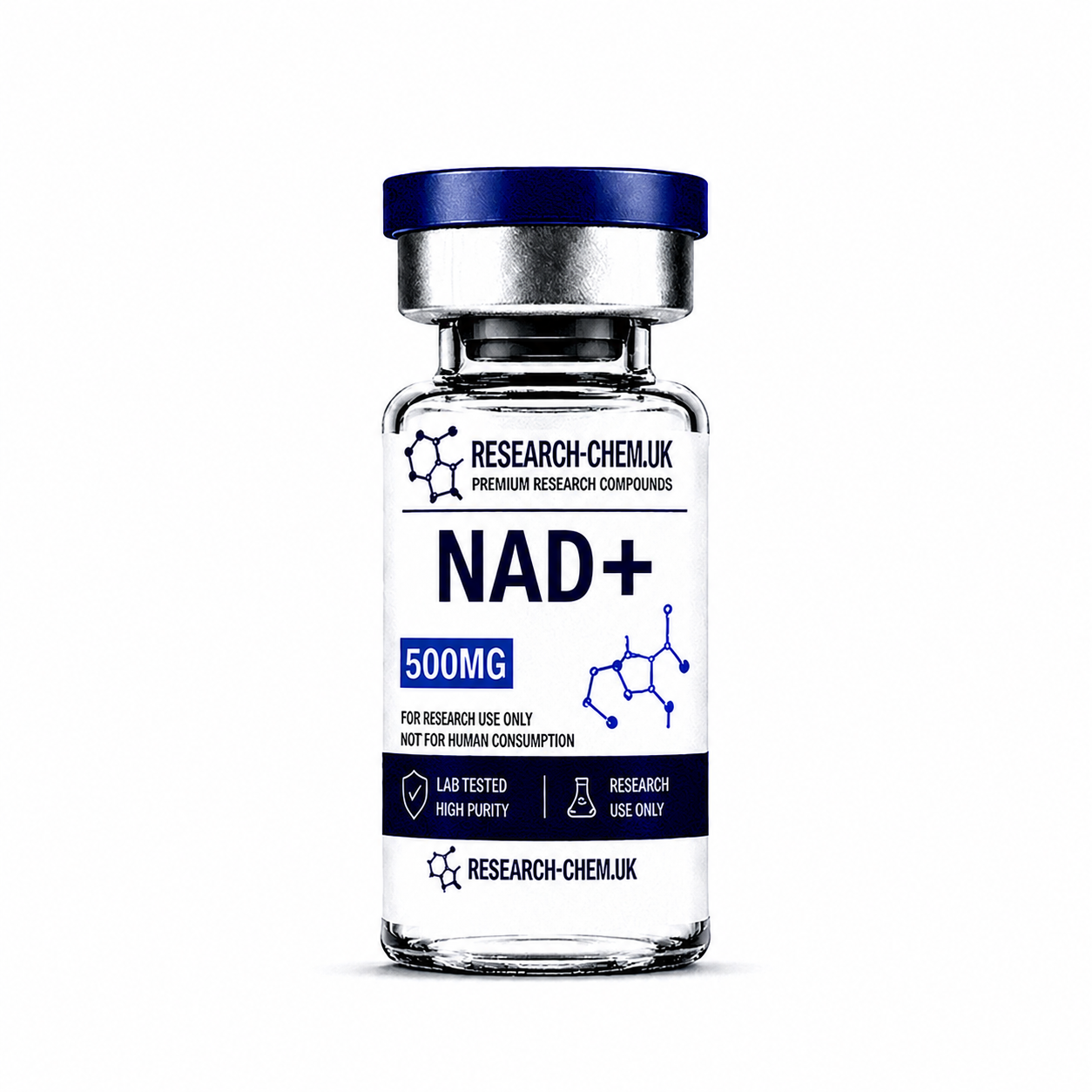
 RESEARCH USE ONLY
500MG
NAD+
500MG · CAS: 53-84-9
Certificate of Analysis
Batch HPLC & MS included
UK Dispatch
Shipped next working day
Research Grade
≥98% documented purity
Discreet Packaging
Plain, secure, tamper-evident
Laboratory Research Use Only: This compound is sold exclusively for qualified in-vitro scientific and laboratory investigation. Strictly not intended for human or veterinary administration.
Product Overview
NAD+ (Nicotinamide Adenine Dinucleotide) is a naturally occurring coenzyme found in virtually all living cells. It plays a fundamental role in cellular metabolism, particularly in oxidation-reduction reactions, mitochondrial energy production, DNA repair and cellular signalling.
NAD+ exists in oxidised and reduced forms, with the NAD+/NADH redox pair acting as an important electron-transfer system in metabolic pathways.
Beyond its role in energy metabolism, NAD+ is involved in several enzyme-mediated signalling processes, including reactions involving sirtuins, PARP enzymes and CD38/CD157, making NAD+ an important subject of research into cellular ageing, metabolic regulation, DNA damage and mitochondrial biology. Research-Chem.uk supplies NAD+ as a laboratory research compound intended strictly for in-vitro, analytical and scientific research applications.
| Key Product Features | |
|---|---|
| Product | NAD+ |
| Vial | 10ml |
| NAD+ Content | 500mg |
| Purity | 99.5% |
| Testing | HPLC verified |
| Documentation | Batch-specific Certificate of Analysis (COA) |
| Application | Laboratory research only |
| Dispatch | UK |
What Is NAD+?
NAD+ stands for nicotinamide adenine dinucleotide. It is a dinucleotide consisting of two nucleotide components linked through their phosphate groups. One nucleotide contains an adenine base, while the other contains nicotinamide.
NAD+ is central to cellular metabolism because it can accept electrons to form NADH. The reversible NAD+/NADH pair allows cells to transfer reducing equivalents between metabolic reactions.
The NAD+/NADH system is particularly important within pathways such as:
- Glycolysis
- The citric acid cycle
- Fatty-acid oxidation
- Oxidative phosphorylation
- Cellular redox regulation
NAD+ also serves as a substrate for several enzyme families. These include sirtuins, which use NAD+ during deacetylation reactions, and poly(ADP-ribose) polymerases (PARPs), which consume NAD+ during DNA-damage signalling. This combination of metabolic and signalling functions makes NAD+ an important research molecule across biochemistry, molecular biology and cellular physiology.
How Is NAD+ Investigated in Research?
NAD+ is investigated extensively in cellular, biochemical and molecular research. Experimental research has examined:
- Cellular energy metabolism
- Mitochondrial function
- Redox balance
- NAD+/NADH ratios
- DNA repair
- Sirtuin activity
- PARP activity
- CD38/CD157 signalling
- Cellular senescence
- Metabolic regulation
- Oxidative stress
- Mitochondrial ageing
- Gene regulation
A particularly important area of research concerns the relationship between NAD+ availability and cellular metabolism. NAD+ is continuously consumed and regenerated through multiple biochemical pathways. Cellular NAD+ concentrations therefore reflect a dynamic balance between synthesis, utilisation and salvage.
Researchers can investigate these pathways by measuring NAD+ and NADH concentrations or by manipulating enzymes involved in NAD+ biosynthesis and consumption.
NAD+ Research Applications
Cellular Energy Research
NAD+ is essential to the transfer of electrons during cellular respiration. Within glycolysis and the citric acid cycle, NAD+ accepts electrons and is converted to NADH. NADH subsequently participates in mitochondrial oxidative phosphorylation. This makes NAD+ relevant to research involving:
- ATP production
- Cellular respiration
- Mitochondrial metabolism
- Electron transport
- Oxidative phosphorylation
- Energy-demanding tissues
Mitochondrial Research
Mitochondria rely heavily on NAD+-dependent metabolic reactions. Research into NAD+ has therefore examined mitochondrial function, respiratory capacity and metabolic flexibility. Changes in NAD+ availability can influence the activity of metabolic enzymes and NAD+-dependent signalling proteins, providing a useful experimental model for investigating mitochondrial physiology.
DNA-Repair Research
NAD+ serves as a substrate for PARP enzymes, which are activated by certain forms of DNA damage. PARP activity can consume substantial amounts of cellular NAD+ under conditions of increased DNA damage. This creates an important connection between NAD+ metabolism and DNA-repair research. Experimental studies can therefore investigate:
- DNA damage
- PARP activation
- NAD+ consumption
- DNA repair pathways
- Cellular stress responses
Sirtuin Research
Sirtuins are NAD+-dependent enzymes involved in protein deacetylation and other signalling reactions. Because sirtuin activity depends directly on NAD+, NAD+ availability is an important variable in research investigating:
- Protein acetylation
- Gene regulation
- Metabolic signalling
- Mitochondrial function
- Cellular stress responses
- Age-associated molecular changes
Cellular Ageing Research
NAD+ metabolism has become an important area of ageing research. Studies have reported changes in NAD+ metabolism during ageing and have investigated the enzymes responsible for NAD+ synthesis, salvage and consumption. Researchers have therefore examined the relationship between NAD+ availability and:
- Cellular senescence
- Mitochondrial function
- DNA repair
- Sirtuin activity
- Metabolic resilience
- Age-associated cellular changes
Importantly, these research findings do not establish NAD+ itself as an anti-ageing treatment. The biological mechanisms are complex and depend on tissue, cellular context and NAD+ metabolic pathways.
Oxidative-Stress Research
NAD+/NADH is a major component of cellular redox biology. The ratio between oxidised NAD+ and reduced NADH provides information about the redox state of cells and can change in response to metabolic or oxidative stress. NAD+ can therefore be used in experimental systems examining:
- Redox balance
- Reactive oxygen species
- Oxidative stress
- Mitochondrial dysfunction
- Metabolic stress
What Does the Research Say?
NAD+ has one of the most established biochemical roles in cellular biology. Its importance was recognised long before modern longevity research because NAD+ is fundamental to cellular respiration and redox metabolism.
More recent research has expanded the understanding of NAD+ beyond its traditional role as an electron carrier. NAD+ is now recognised as a substrate for enzymes involved in cellular signalling, including sirtuins and PARPs. This creates a connection between NAD+ metabolism, energy production, DNA repair and cellular stress responses.
Research into ageing has also identified changes in NAD+ metabolism in multiple tissues. A decline in NAD+ availability has been investigated as one component of the broader metabolic changes associated with ageing, although the mechanisms are complex and vary between biological systems.
A major area of research is therefore the NAD+ salvage pathway, particularly the conversion of nicotinamide back into NAD+. Enzymes including NAMPT play important roles in maintaining intracellular NAD+ pools.
Other research has focused on NAD+-consuming enzymes such as PARPs and CD38. These pathways provide important mechanisms through which NAD+ availability can change under conditions of DNA damage, inflammation and cellular stress.
The growing research interest in NAD+ therefore encompasses much more than energy metabolism. It includes the interaction between metabolic state, mitochondrial function, DNA repair and cellular signalling. For laboratory research, NAD+ provides a well-established biochemical substrate for investigating these interconnected pathways.
Research References
-
Bender E, et al. (2019). NAD+ metabolism in health and disease. Nature Reviews Molecular Cell Biology.
Review examining NAD+ biosynthesis, consumption and cellular signalling.
-
Rajman L, Chwalek K, Sinclair DA. (2018). Therapeutic Potential of NAD-Boosting Molecules: The In Vivo Evidence. Cell Metabolism, 27(3), 529–547.
PMID: 29415893 · DOI: 10.1016/j.cmet.2018.02.011
-
Katsyuba E, Auwerx J. (2017). Modulating NAD+ metabolism, from bench to bedside. The EMBO Journal, 36(18), 2670–2683.
PMID: 28808120 · DOI: 10.15252/embj.201797135
-
Covarrubias AJ, Perrone R, Grozio A, Verdin E. (2021). AMPK and NAD+ metabolism in the regulation of aging. Molecular Cell, 81(2), 399–416.
Research examining the relationship between NAD+ metabolism, cellular energy sensing and ageing-associated pathways.
-
Verdin E. (2015). NAD+ in aging, metabolism, and neurodegeneration. Science, 350(6265), 1208–1213.
PMID: 26785480 · DOI: 10.1126/science.aac4854
NAD+ Product Specifications
| Specification | Details |
|---|---|
| Product Name | NAD+ |
| Full Name | Nicotinamide Adenine Dinucleotide |
| Vial Size | 10ml |
| NAD+ Content | 500mg |
| Purity | 99.5% |
| Testing Method | HPLC |
| Compound Type | Dinucleotide coenzyme |
| Redox Pair | NAD+ / NADH |
| Physical Form | Laboratory research material |
| Intended Application | Laboratory research only |
NAD+ is a nucleotide-derived coenzyme rather than a peptide. Its biological role is primarily associated with electron transfer, cellular metabolism and NAD+-dependent enzyme activity.
Quality and Purity
At Research-Chem.uk, analytical quality and batch traceability are central to our research compound range.
This NAD+ batch is supplied with a stated 99.5% purity, with HPLC analysis used to assess the supplied material. Each batch is supported by a Certificate of Analysis (COA) providing analytical documentation for the supplied material.
The product is supplied in a 10ml vial containing 500mg of NAD+. Researchers should always refer to the relevant batch-specific COA when recording analytical characteristics for experimental work.
Laboratory Research Applications
NAD+ may be suitable for laboratory investigations involving:
- Cellular metabolism
- Mitochondrial biology
- Oxidative phosphorylation
- Redox biology
- NAD+/NADH metabolism
- ATP production
- DNA-repair pathways
- PARP biology
- Sirtuin research
- CD38-related research
- Cellular senescence
- Oxidative-stress models
- Metabolic signalling
- Age-associated cellular processes
- Enzyme kinetics
- Biochemical research
- Analytical research
NAD+ is supplied strictly as a research compound and is not intended to diagnose, treat, cure or prevent any disease or medical condition.
Why Choose Research-Chem.uk?
Research-Chem.uk provides research compounds and peptides for laboratories, analytical researchers and other qualified research environments. Our range focuses on:
HPLC-Verified Purity
Products are subjected to analytical purity assessment, with batch-specific documentation available.
Batch Traceability
Products are supplied with Certificate of Analysis documentation to support laboratory record keeping and material identification.
UK Dispatch
Research compounds are dispatched from the UK for efficient domestic delivery.
Research-Only Positioning
Our products are supplied exclusively for legitimate laboratory research and analytical applications.
Clear Product Specifications
Each product page provides defined information about compound content, purity and relevant scientific characteristics.
Research-Use Disclaimer
For laboratory research use only. Not for human or veterinary use.
NAD+ supplied by Research-Chem.uk is intended strictly for in-vitro laboratory research, analytical testing and scientific investigation.
This product is not a medicine, pharmaceutical preparation, dietary supplement or food product. It is not intended for human consumption, self-administration, diagnosis, treatment, cure or prevention of any disease or medical condition.
The scientific information presented on this page summarises published research concerning NAD+ biology and metabolism. Experimental findings should not be interpreted as recommendations for human use or as evidence that this particular Research-Chem.uk batch has been clinically evaluated.
Researchers and laboratories are responsible for ensuring that all use, handling, storage, testing and disposal procedures comply with applicable legislation, institutional requirements and laboratory safety protocols.
For qualified researchers and controlled laboratory research use only.