


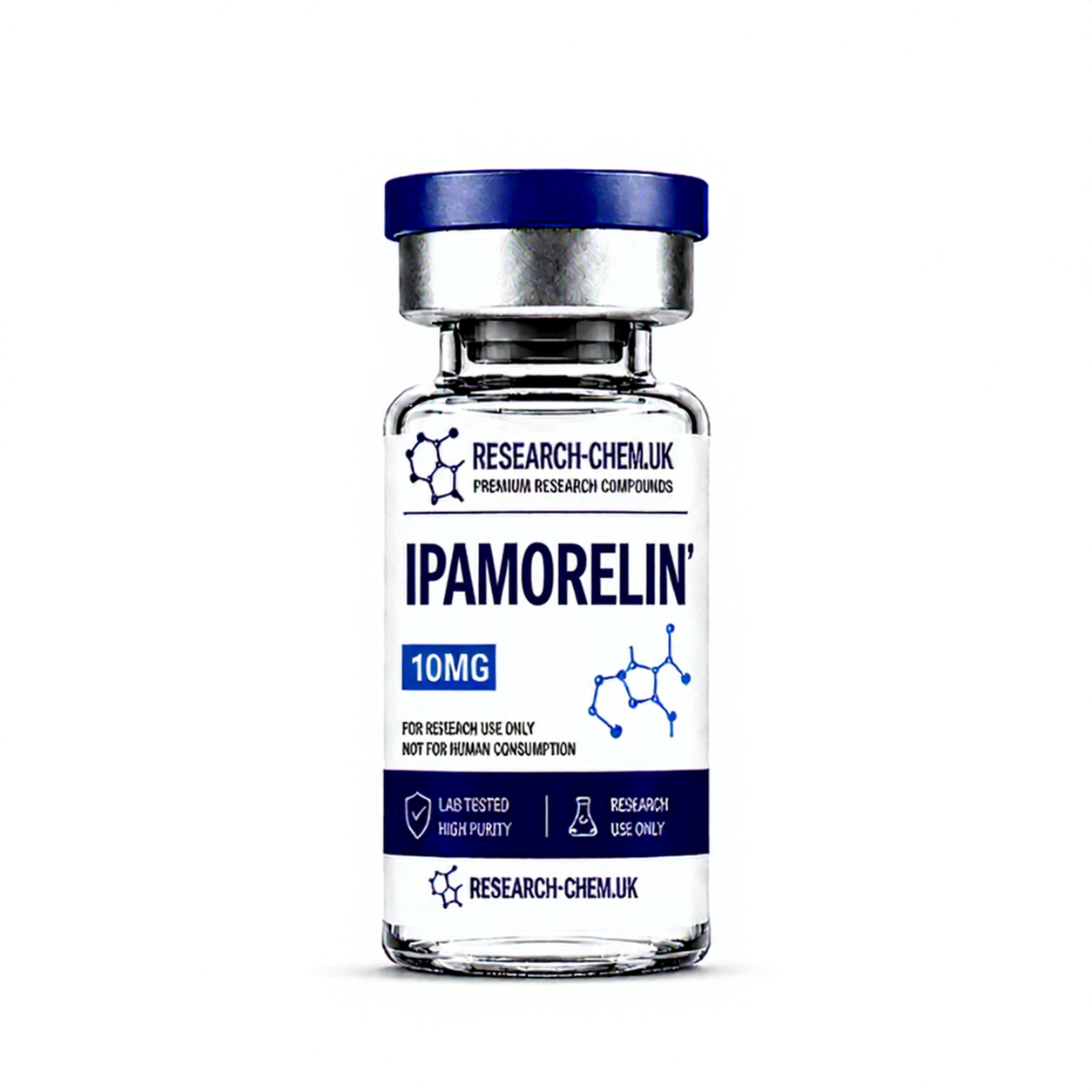
 RESEARCH USE ONLY
10MG
Ipamorelin
10MG · CAS: 170851-70-4
Certificate of Analysis
Batch HPLC & MS included
UK Dispatch
Shipped next working day
Research Grade
≥98% documented purity
Discreet Packaging
Plain, secure, tamper-evident
Laboratory Research Use Only: This compound is sold exclusively for qualified in-vitro scientific and laboratory investigation. Strictly not intended for human or veterinary administration.
Product Overview
Ipamorelin is a synthetic research peptide supplied for laboratory and in-vitro research applications. It belongs to a class of compounds known as growth hormone secretagogues and has been investigated extensively for its ability to stimulate the release of growth hormone through the growth hormone secretagogue receptor.
Originally developed during research into selective growth hormone-releasing compounds, Ipamorelin has been studied in cellular, animal and human pharmacological models. Research has examined Ipamorelin in relation to growth hormone secretion, receptor activity, pharmacokinetics and broader endocrine signalling.
For laboratory and in-vitro research only. Not intended for human or veterinary use. Ipamorelin is not presented as a licensed medicine.
What Is Ipamorelin?
Ipamorelin is a synthetic pentapeptide growth hormone secretagogue. It was developed as part of a research programme investigating compounds capable of stimulating growth hormone release while maintaining greater selectivity than earlier growth hormone-releasing peptides.
The original published research identified Ipamorelin as a pentapeptide with the sequence: Aib-His-D-2-Nal-D-Phe-Lys-NH₂
Ipamorelin was shown in experimental models to stimulate growth hormone release through a GHRP-like receptor mechanism. The compound demonstrated activity in rat pituitary-cell assays as well as in animal models. Subsequent research has investigated the pharmacology and pharmacokinetics of Ipamorelin, including studies in healthy human volunteers.
Peptide Structure
Ipamorelin consists of five amino-acid residues and incorporates several structural features that distinguish it from naturally occurring peptides. The commonly reported sequence is Aib-His-D-2-Nal-D-Phe-Lys-NH₂. Ipamorelin acetate is also encountered in research and analytical literature. Researchers should consult the applicable product documentation for the precise form and analytical characteristics of the supplied material.
Growth Hormone Secretagogue Activity
The original pharmacological research demonstrated that Ipamorelin stimulated growth hormone release from rat pituitary cells and produced growth hormone responses in rat and swine models. This activity made Ipamorelin an important research compound for investigating the mechanisms controlling growth hormone secretion.
Receptor Activity
Ipamorelin acts through a GHRP-like receptor mechanism associated with the growth hormone secretagogue receptor. This receptor forms part of the signalling system involved in growth hormone secretion. Investigating compounds that activate this receptor has helped researchers understand the pharmacology of growth hormone secretagogues and their relationship with endogenous hormonal signalling.
How Is Ipamorelin Investigated in Research?
Growth Hormone Release
The principal area of Ipamorelin research is its effect on growth hormone secretion. The original studies demonstrated growth hormone release in cultured rat pituitary cells as well as in animal models. In rat pituitary-cell assays, Ipamorelin produced a strong growth hormone response, while experiments in rats and swine demonstrated growth hormone release following administration.
Growth Hormone Secretagogue Receptor
Ipamorelin is used in research involving the growth hormone secretagogue receptor, sometimes referred to as GHS-R or the ghrelin receptor. This receptor forms part of the signalling system involved in growth hormone secretion. Investigating compounds that activate this receptor has helped researchers understand the pharmacology of growth hormone secretagogues and their relationship with endogenous hormonal signalling.
Selectivity Research
One of the characteristics that originally distinguished Ipamorelin from several earlier GHRPs was its reported selectivity for growth hormone release. In the original experimental work, researchers examined several pituitary hormones and reported that Ipamorelin did not significantly increase ACTH or cortisol in the same manner observed with GHRP-2 and GHRP-6. This selectivity was one of the principal reasons for the compound's continued scientific interest.
Pharmacokinetic Research
Ipamorelin has also been investigated in human pharmacokinetic and pharmacodynamic research. A study involving healthy male volunteers examined different infusion rates and measured both Ipamorelin concentrations and growth hormone responses. The study characterised the relationship between circulating Ipamorelin concentrations and the resulting growth hormone response. This research provides useful pharmacological information about the compound but should not be interpreted as evidence establishing Ipamorelin as an approved therapeutic product.
Comparative Secretagogue Research
Ipamorelin has been compared experimentally with other growth hormone secretagogues, including GHRP-2 and GHRP-6. These comparisons have examined factors such as:
- Growth hormone potency
- Growth hormone response
- Receptor activity
- Hormonal selectivity
- Pharmacokinetic behaviour
- Structure-activity relationships
Ipamorelin Research Applications
Ipamorelin has been investigated across a range of endocrine and pharmacological research areas. Research applications include:
- Growth hormone research: investigation of growth hormone secretion and regulation
- GHS-R research: investigation of growth hormone secretagogue receptor activity
- Pituitary research: study of hormone release from pituitary cells
- Endocrine pharmacology: investigation of peptide-mediated hormonal signalling
- Pharmacodynamics: examination of dose-response relationships and hormonal responses
- Pharmacokinetics: investigation of distribution and elimination characteristics
- Receptor selectivity: comparison of Ipamorelin with other growth hormone secretagogues
- Comparative pharmacology: investigation alongside GHRP-2, GHRP-6 and related compounds
- Metabolic research: investigation of pathways associated with growth hormone signalling
- Hormone research: examination of interactions between growth hormone and other endocrine pathways
- Cell-based research: investigation using pituitary and receptor-expressing cell systems
- Animal research: experimental investigation of endocrine responses
- Peptide research: analytical characterisation and stability studies
- Structure-activity research: investigation of peptide modifications and receptor activity
These applications describe areas of scientific investigation rather than established medical uses.
What Does the Research Say?
Ipamorelin has a well-established pre-clinical research history and has also been examined in human pharmacological studies. However, the nature of the evidence should be considered carefully, particularly when distinguishing pharmacological research from evidence supporting medical use.
Original Pharmacological Research
The foundational Ipamorelin research was published in 1998 and described the development and pharmacology of the compound. The researchers identified Ipamorelin as a potent growth hormone secretagogue and investigated its effects in rat pituitary cells, rats and swine. The study reported significant growth hormone responses and found that Ipamorelin acted through a GHRP-like receptor mechanism. Importantly, the researchers also examined other pituitary hormones. Ipamorelin showed a comparatively selective hormonal response in the experimental models studied, particularly when compared with GHRP-2 and GHRP-6.
Structure and Drug Development Research
Further research examined compounds derived from the Ipamorelin structure. Scientists investigated modifications designed to produce compounds with different pharmacological properties, including improved oral bioavailability. This research demonstrated that the Ipamorelin structure could be used as a starting point for developing new growth hormone secretagogues and helped expand understanding of structure-activity relationships within this class of compounds.
Human Pharmacokinetic Research
Ipamorelin has also been studied in healthy human volunteers. A pharmacokinetic-pharmacodynamic study examined the relationship between circulating Ipamorelin concentrations and growth hormone release. The researchers characterised the pharmacokinetic profile and associated growth hormone response following controlled infusion. This research provides useful pharmacological information about the compound but should not be interpreted as evidence establishing Ipamorelin as an approved medicine.
Broader Growth Hormone Secretagogue Research
Ipamorelin has also been included in broader scientific research examining growth hormone secretagogues. This wider literature has investigated the relationship between GHS-R activation, growth hormone secretion and other metabolic or endocrine pathways. Researchers have also examined whether growth hormone secretagogues can produce effects that are independent of growth hormone itself, highlighting the importance of studying each compound's pharmacology separately.
Interpreting the Evidence
The available Ipamorelin literature includes laboratory, animal and human pharmacological research. Researchers should distinguish between:
- Receptor and cell-based studies
- Animal pharmacology
- Human pharmacokinetic studies
- Clinical efficacy research
- Regulatory approval
- Commercial or anecdotal claims
The existence of human pharmacological data does not mean that an unapproved research product has established therapeutic safety or effectiveness.
Research References
The following publications provide useful background for researchers investigating Ipamorelin and growth hormone secretagogues:
- Raun K et al. (1998). Ipamorelin, the first selective growth hormone secretagogue. European Journal of Endocrinology, 139(5), 552–561. This foundational study described the development, receptor activity and pharmacology of Ipamorelin in cellular and animal models.
- Ankersen M et al. (1998). A new series of highly potent growth hormone-releasing peptides derived from ipamorelin. Journal of Medicinal Chemistry, 41(19), 3699–3704. This study investigated compounds derived from the Ipamorelin structure and explored their growth hormone secretagogue activity.
- Hansen BS et al. (1999). Pharmacological characterisation of a new oral GH secretagogue, NN703. European Journal of Endocrinology. This work investigated a growth hormone secretagogue developed from the Ipamorelin research programme.
- Pharmacokinetic-pharmacodynamic modelling of Ipamorelin in human volunteers. This research examined the pharmacokinetic and growth hormone response characteristics of Ipamorelin in healthy volunteers.
- Growth hormone-independent stimulation of adiposity by GH secretagogues. This study investigated metabolic effects of growth hormone secretagogues, including Ipamorelin, in animal models and demonstrated why effects beyond growth hormone secretion require separate investigation.
Researchers should consult the original publications when assessing experimental methodology, participant populations, endpoints, pharmacological findings and study limitations.
Ipamorelin Product Specifications
| Property | Specification |
|---|---|
| Product | Ipamorelin |
| Peptide class | Growth hormone secretagogue |
| Peptide type | Synthetic pentapeptide |
| Common sequence | Aib-His-D-2-Nal-D-Phe-Lys-NH₂ |
| Vial size | 3ml |
| Peptide quantity | 10mg |
| Stated purity | 99.3% |
| Analytical testing | HPLC |
| Documentation | Batch-specific Certificate of Analysis |
| Intended use | Laboratory and in-vitro research only |
The applicable Certificate of Analysis should always be consulted for the specific analytical results associated with an individual product batch.
Quality and Purity
Analytical documentation is an important consideration when working with research peptides. Research-Chem.uk's Ipamorelin is supplied as a 10mg research product in a 3ml vial with a stated purity of 99.3%. Batch-specific documentation allows researchers to review the analytical information associated with the relevant product batch.
HPLC analysis provides an important analytical method for assessing peptide purity and supporting quality-control procedures.
Researchers should always review the Certificate of Analysis corresponding to the particular batch rather than relying solely on general product specifications.
Laboratory Research Applications
Ipamorelin may be investigated as a research material in controlled laboratory studies involving:
- Growth hormone secretion
- Growth hormone secretagogue receptor research
- Pituitary-cell research
- Endocrine signalling
- Growth hormone pharmacology
- Receptor-binding studies
- Hormonal dose-response research
- Pharmacokinetic studies
- Pharmacodynamic studies
- Comparative GHRP research
- GHRP-2 and GHRP-6 comparison studies
- Structure-activity relationship research
- Metabolic signalling
- Peptide stability studies
- Analytical chemistry
- Peptide characterisation
- Receptor selectivity research
- Animal endocrine models
- Cell-based hormone-release assays
The appropriate research methodology and experimental conditions should be established by suitably qualified researchers in accordance with applicable laboratory procedures.
Why Choose Research-Chem.uk?
Research-Chem.uk supplies research-grade compounds intended for controlled laboratory and scientific investigation. For Ipamorelin, Research-Chem.uk provides:
- 10mg Ipamorelin research product
- 3ml vial
- 99.3% stated purity
- HPLC analytical testing
- Batch-specific COA documentation
- UK-based supply
- Documentation designed to support laboratory research and analytical verification
The availability of batch-specific documentation allows researchers to review the analytical information associated with the particular product batch supplied. Researchers should consult the relevant COA for the most current batch-specific information.
Research-Use Disclaimer
Ipamorelin is supplied strictly as a research compound for laboratory and in-vitro scientific investigation.
It is not intended for human consumption, self-administration, veterinary use, diagnosis, treatment, prevention of disease, or any other medical or therapeutic purpose.
Ipamorelin is not presented as an approved medicine. Although the compound has been investigated in laboratory, animal and human pharmacological studies, research findings should not be interpreted as evidence that an unapproved research product has established therapeutic safety or effectiveness.
The published research should be interpreted in the context of the specific experimental model, formulation, concentration or dose, route of administration and study population involved.
Human pharmacological findings provide information about the compound's pharmacology and disposition but should not be used as instructions for human administration.
Researchers are responsible for ensuring that their use of research compounds complies with all applicable legislation, institutional requirements, laboratory procedures and relevant regulatory standards.
For qualified researchers and controlled laboratory research use only.