












 RESEARCH USE ONLY
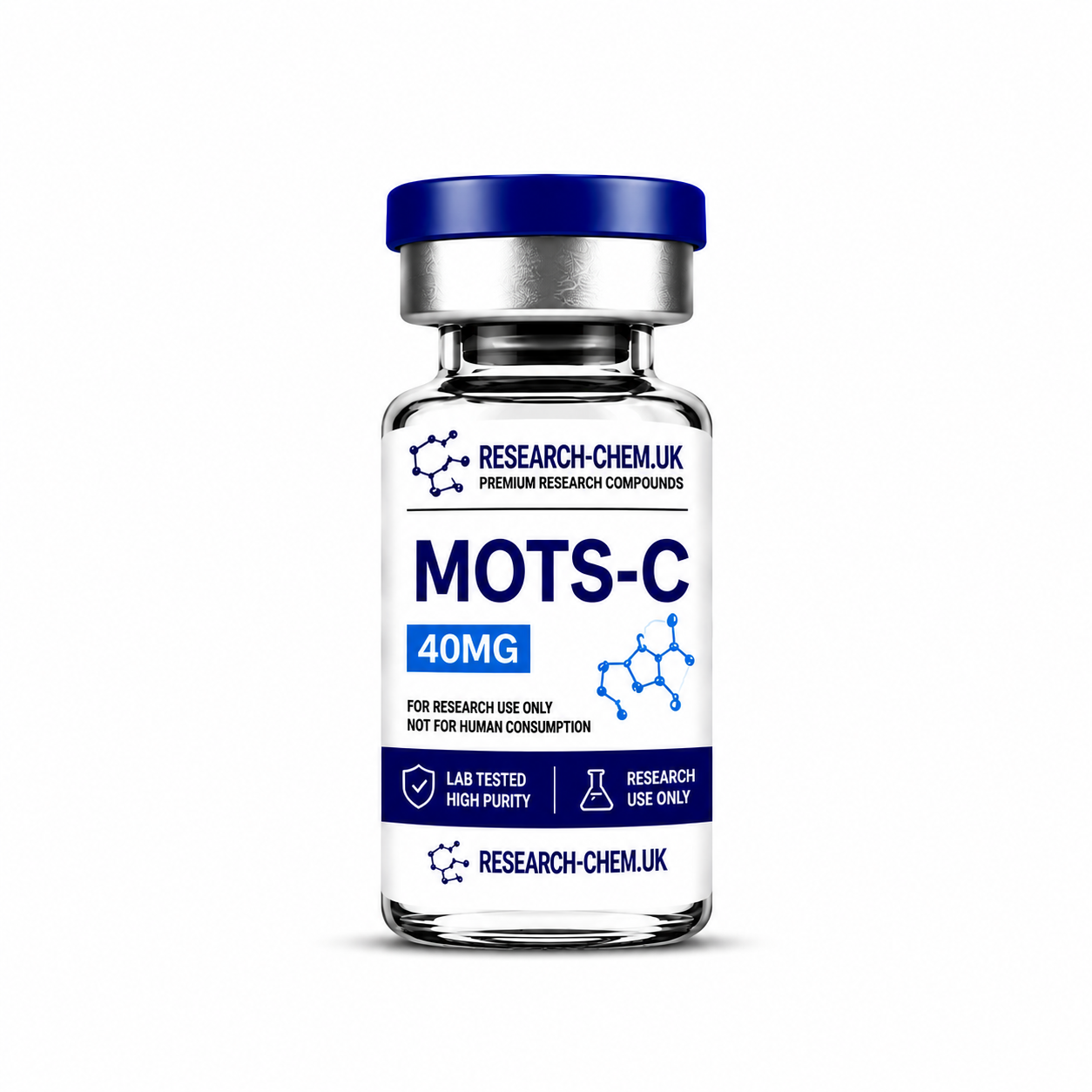
40 mg
MOTS-c UK
40 mg · CAS: 1627580-64-6
Certificate of Analysis
Batch HPLC & MS included
UK Dispatch
Shipped next working day
Research Grade
≥98% documented purity
Discreet Packaging
Plain, secure, tamper-evident
Laboratory Research Use Only: This compound is sold exclusively for qualified in-vitro scientific and laboratory investigation. Strictly not intended for human or veterinary administration.
Product Overview
MOTS-c 40mg UK | Mitochondrial-Derived Research Peptide | HPLC Verified | £59.95
Product Overview
MOTS-c 40mg is a mitochondrial-derived research peptide attracting scientific interest for its potential role in cellular energy regulation, metabolic signalling and mitochondrial-to-nuclear communication.
Encoded within the mitochondrial genome, MOTS-c is a 16-amino-acid peptide investigated for its relationship with AMP-activated protein kinase (AMPK), glucose metabolism, insulin sensitivity and metabolic homeostasis.
Research has explored how MOTS-c may influence cellular responses to metabolic stress and the pathways involved in energy utilisation. These findings have established MOTS-c as an emerging subject in mitochondrial biology and experimental metabolic research.
Research-Chem.uk MOTS-c 40mg is supplied strictly for laboratory research and analytical purposes. The product's reported purity and analytical characteristics should be verified against the relevant batch-specific Certificate of Analysis (COA).
Product Highlights
1. Product: MOTS-c
2. Quantity: 40mg
3. Price: £59.95
4. Compound class: Mitochondrial-derived peptide
5. Peptide length: 16 amino acids
6. Research focus: Mitochondrial signalling and metabolic regulation
7. Documentation: Refer to the applicable batch-specific COA
8. Intended use: Laboratory research and analytical purposes only
What Is MOTS-c?
MOTS-c stands for mitochondrial open reading frame of the 12S rRNA-c. First characterised in 2015, it is a short peptide encoded by a region of mitochondrial DNA.
Mitochondria are best known for their role in cellular energy production, but research increasingly recognises their importance in cellular signalling. Mitochondrial-derived peptides such as MOTS-c are being investigated for their potential role in communicating metabolic information between mitochondria and other cellular systems.
Unlike conventional peptides encoded by nuclear DNA, MOTS-c originates from the mitochondrial genome. This distinctive origin makes it particularly relevant to research examining mitochondrial function, metabolic adaptation and cellular homeostasis.
Scientific investigations have explored MOTS-c in relation to:
a. AMPK-associated signalling pathways
b. Glucose utilisation and metabolic regulation
c. Insulin sensitivity in experimental models
d. Cellular energy homeostasis
e. Skeletal muscle metabolism
f. Responses to metabolic stress
g.Mitochondrial-to-nuclear communication
h.Age-associated metabolic changes
Although these areas have generated considerable scientific interest, MOTS-c remains investigational. Findings from cell-based and animal studies should not be interpreted as proof of equivalent effects in humans.
How Is MOTS-c Investigated in Research?
One of the principal areas of interest in MOTS-c research is its relationship with AMP-activated protein kinase (AMPK), an enzyme that functions as a cellular energy sensor.
AMPK helps coordinate metabolic processes in response to changes in cellular energy availability. It participates in pathways associated with glucose utilisation, lipid metabolism and energy balance.
In foundational preclinical research, MOTS-c was associated with changes in folate metabolism, purine biosynthesis and AMPK activation. These findings helped establish a scientific basis for further investigation into mitochondrial-derived signalling peptides.
Researchers continue to explore several related questions:
How MOTS-c influences intracellular metabolic pathways
How mitochondrial-derived signals affect gene expression
How cellular responses vary under different metabolic conditions
How MOTS-c relates to skeletal muscle energy utilisation
How its biological activity differs between experimental models
The precise mechanisms, pharmacological characteristics and clinical relevance of MOTS-c remain incompletely understood.
MOTS-c Research Applications
1. Mitochondrial Signalling
MOTS-c offers researchers an opportunity to investigate how mitochondria may influence cellular activity beyond their traditional role in energy production.
Research into mitochondrial-derived peptides is expanding understanding of the relationship between mitochondrial function, gene regulation and cellular adaptation.
2. AMPK and Energy Regulation
AMPK is an important regulator of cellular energy balance. MOTS-c has been investigated in experimental systems involving AMPK-related pathways and changes in metabolic activity.
This research may help laboratories explore the molecular mechanisms involved in energy sensing and metabolic regulation.
3. Glucose Metabolism and Insulin Signalling
Preclinical research has investigated MOTS-c in relation to glucose utilisation and insulin sensitivity.
The original 2015 study reported that MOTS-c treatment improved measures associated with insulin resistance and diet-related obesity in mice. These findings established an important foundation for further research.
However, animal findings do not demonstrate that administering MOTS-c produces equivalent benefits in humans. Its potential role in human glucose regulation remains unestablished.
4. Skeletal Muscle Metabolism
Skeletal muscle plays a major role in whole-body glucose utilisation and energy metabolism.
Researchers have investigated MOTS-c in relation to muscle metabolic activity and physiological adaptation. This work has generated interest in the relationship between mitochondrial signalling and the regulation of skeletal muscle energy pathways.
Further research is required to establish the relevance of these findings to human physiology.
5. Metabolic Stress and Cellular Adaptation
MOTS-c is also being investigated for its potential involvement in cellular responses to metabolic stress.
Understanding these mechanisms may help researchers examine how cells adapt to changes in energy availability and metabolic demand.
These investigations remain part of an evolving scientific field rather than an established clinical application.
6. Ageing and Metabolic Research
Mitochondrial function and metabolic regulation can change with age. Researchers are therefore investigating whether mitochondrial-derived peptides contribute to age-associated physiological changes.
MOTS-c has attracted interest in this field because of its reported relationship with metabolic homeostasis in preclinical models.
It has not been established that taking MOTS-c slows ageing, extends lifespan or prevents age-related disease.
What Does the Research Say?
MOTS-c research includes cellular experiments, animal studies and human observational research. The strength of evidence varies considerably between these areas.
Preclinical Findings
A foundational study published in Cell Metabolism in 2015 identified MOTS-c as a mitochondrial-derived peptide and investigated its effects on metabolic homeostasis.
In experimental models, researchers reported changes associated with AMPK signalling, insulin sensitivity and diet-related obesity.
These findings provide a basis for continued investigation into mitochondrial-derived peptides and their potential involvement in metabolic regulation.
Human Research
Human studies have examined naturally occurring MOTS-c concentrations in blood and their relationships with metabolic characteristics.
However, observational measurements of naturally occurring MOTS-c are not equivalent to clinical trials in which participants receive manufactured MOTS-c.
The available evidence does not establish the safety, effectiveness or clinical benefits of administering native MOTS-c to humans.
Scientific Limitations
Important questions remain regarding MOTS-c's biological mechanisms, pharmacokinetics, dose-response relationships, potential adverse effects and long-term safety.
Accordingly, claims that MOTS-c is a proven weight-management, anti-ageing, performance-enhancing or metabolic treatment are not supported by established human clinical evidence.
Research References
1. Lee et al. (2015) — MOTS-c and Metabolic Homeostasis
Title: The mitochondrial-derived peptide MOTS-c promotes metabolic homeostasis and reduces obesity and insulin resistance.
Journal: Cell Metabolism, 21(3), 443–454.
DOI: 10.1016/j.cmet.2015.02.009
This foundational study characterised MOTS-c and investigated its relationship with metabolic regulation, AMPK-associated signalling and insulin sensitivity in experimental models.
Read the study on PubMed
2. Kim and Ristow (2015) — Mitochondrial Signalling and Metabolism
Title: A mitochondrially encoded hormone ameliorates obesity and insulin resistance.
Journal: Cell Metabolism.
DOI: 10.1016/j.cmet.2015.02.013
This accompanying research article discusses the potential significance of MOTS-c in mitochondrial signalling and metabolic regulation.
Read the study on PubMed
3. MOTS-c and Muscle and Fat Metabolism
Title: MOTS-c: A novel mitochondrial-derived peptide regulating muscle and fat metabolism.
This review examines the emerging research surrounding mitochondrial-derived peptides and their potential roles in skeletal muscle and metabolic biology.
Find the publication on PubMed
MOTS-c Product Specifications
Property
Specification
Product name: MOTS-c
Product quantity: 40mg
Price: £59.95
Full name: Mitochondrial open reading frame of the 12S rRNA-c
Compound class: Mitochondrial-derived peptide
Peptide length: 16 amino acids
Peptide sequence: MRWQEMGYIFYPRKLR
Primary research areas: Mitochondrial signalling and metabolic regulation
Reported purity
Refer to batch-specific COA
Intended application
Laboratory research and analytical purposes
Product-specific chemical identity, salt form, analytical purity and batch information should be confirmed using the relevant product documentation.
Quality and Purity
At Research-Chem.uk, analytical verification and batch traceability are important considerations when supplying research compounds.
The applicable Certificate of Analysis provides the reference for the tested batch's reported purity and available analytical information.
HPLC analysis can help characterise the chromatographic purity of a peptide preparation. However, purity results alone do not establish biological activity, sterility, formulation suitability or safety for administration.
Researchers should consult the relevant batch documentation before using the material in an analytical or experimental setting.
Laboratory Research Applications
MOTS-c may be of interest to qualified research laboratories investigating:
Mitochondrial-derived peptide biology
AMPK-associated signalling
Cellular energy regulation
Glucose and lipid metabolism
Insulin-related signalling pathways
Skeletal muscle metabolism
Metabolic stress responses
Mitochondrial-to-nuclear communication
Peptide identification and characterisation
Analytical chemistry and chromatographic methods
Experimental findings should be interpreted in the context of the research model, analytical methodology and limitations of the available evidence.
Why Choose Research-Chem.uk?
Laboratory-Focused Supply
Research-Chem.uk supplies compounds for laboratory research and analytical applications.
Analytical Documentation
Batch-specific documentation provides a reference for the reported analytical characteristics of the supplied material.
Research Traceability
Clear product identification and batch records support transparent research documentation.
Scientifically Responsible Information
Our product descriptions distinguish between established chemical information, preclinical findings and clinical claims that remain unproven.
Research-Only Positioning
We present investigational compounds within a laboratory research context rather than marketing them as medicines, supplements or proven treatments.
Research-Use Disclaimer
MOTS-c 40mg is supplied by Research-Chem.uk strictly for laboratory research and analytical purposes.
This product is not intended for human consumption, veterinary use, diagnosis, treatment, prevention of disease or use as a dietary supplement.
MOTS-c remains an investigational research peptide. Findings from preclinical studies do not establish that the peptide is safe or effective for human use.
Researchers are responsible for ensuring that handling, storage, analysis and disposal comply with applicable laboratory, institutional and regulatory requirements.
For laboratory research only. Not for human or veterinary use.
| Key Product Features | |
|---|---|
| Product | MOTS-c UK |
| Vial Quantity | 40 mg |
| Purity Threshold | ≥98.0% (HPLC) |
| Molecular Formula | C₁₀₁H₁₅₂N₂₈O₂₂S₂ |
| Molecular Weight | Approximately 2,174.6 g/mol |
| CAS Number | 1627580-64-6 |
| Physical Form | White lyophilised powder |
| Documentation | Batch-specific Certificate of Analysis (COA) |
| Intended Application | In-vitro scientific laboratory research only |
| Origin / Dispatch | United Kingdom (Shipped next working day) |
MOTS-c UK Product Specifications
Primary Sequence:
Mitochondrial open reading frame of the 12S rRNA-c
| Specification | Details |
|---|---|
| Product Name | MOTS-c UK |
| CAS Number | 1627580-64-6 |
| Molecular Formula | C₁₀₁H₁₅₂N₂₈O₂₂S₂ |
| Molecular Weight | Approximately 2,174.6 g/mol |
| Stated Purity | ≥98.0% (HPLC) |
| Peptide Sequence | Mitochondrial open reading frame of the 12S rRNA-c |
| Solvent Matrix | Bacteriostatic or sterile water for injection |
| Appearance | White lyophilised powder |
| Storage Specification | −20 °C long-term; 2–8 °C short-term |
| Testing Method | High-Performance Liquid Chromatography (HPLC) & Mass Spectrometry (MS) |
| Analytical Documentation | Batch-specific Certificate of Analysis (COA) |
| Intended Application | Laboratory research use only (in-vitro) |
Quality and Analytical Standards
At Research-Chem.uk, analytical quality, purity verification, and batch traceability are paramount across our entire research catalogue.
Every batch of MOTS-c UK undergoes rigorous analytical evaluation via High-Performance Liquid Chromatography (HPLC) and Mass Spectrometry (MS) to verify molecular mass, peptide sequence integrity, and chemical purity. Batch-specific Certificates of Analysis (COA) are provided for qualified laboratory record-keeping and audit compliance.
Our quality-assurance framework guarantees reproducible standards for scientific investigation, analytical assay development, and academic research.
Laboratory Research Applications
MOTS-c UK is supplied exclusively as a reference compound for controlled in-vitro scientific research. Documented experimental applications include:
- In-vitro cellular signalling and biochemical pathway investigations
- Analytical assay validation and high-performance chromatographic reference standardisation
- Receptor binding affinity and enzyme kinetic profiling
- Molecular interaction and quantitative cellular response studies
Strictly not for clinical diagnostic procedures, therapeutic administration, or any form of in-vivo human or veterinary testing.
Why Choose Research-Chem.uk?
HPLC-Verified Purity
Every research compound is verified with chromatographic analysis and supplied with batch-specific purity documentation.
Batch Traceability
Comprehensive documentation and Certificate of Analysis (COA) reports accompany research lots for full experimental reproducibility.
UK Domestic Dispatch
Dispatched directly from within the United Kingdom for reliable, prompt domestic transit in temperature-controlled packaging.
Research-Only Standard
Dedicated strictly to qualified academic, clinical, and industrial research environments.
Transparent Specifications
Full disclosure of molecular weight, CAS registry, purity threshold, and chemical storage recommendations.
Research-Use Disclaimer
For laboratory research use only. Strictly not for human or veterinary administration.
MOTS-c UK supplied by Research-Chem.uk is intended exclusively for in-vitro scientific study, analytical testing, and laboratory evaluation.
This compound is not a medication, drug, medical device, dietary supplement, or cosmetic. It is not approved by regulatory authorities for the diagnosis, treatment, cure, mitigation, or prevention of any disease or condition in humans or animals.
Purchasers are solely responsible for ensuring handling, storage, and laboratory utilization comply with all relevant UK statutory provisions, COSHH assessments, and institutional safety regulations.